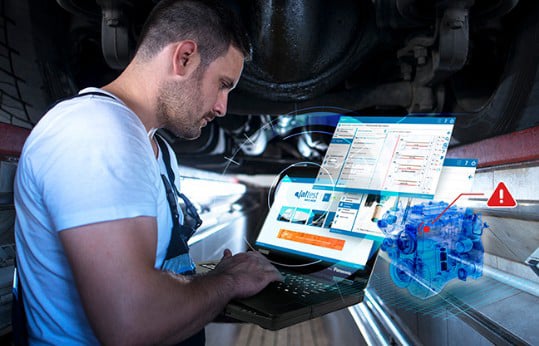
Modern commercial vehicles contain increasingly complex electronic systems controlling everything from engine performance and emissions to braking, transmission, suspension and safety functions. For workshops maintaining trucks, trailers, buses and light commercial vehicles, fault finding now depends heavily on electronic diagnostics as well as traditional mechanical knowledge. A suitable diagnostic platform can help technicians identify faults more quickly, access vehicle data and carry out maintenance procedures that would otherwise be difficult to perform efficiently.
Jaltest Diagnostics is a multi-brand and multi-system diagnostic platform designed for commercial vehicles and other specialist equipment. Its commercial vehicle coverage includes trucks, buses, trailers and light commercial vehicles, while the wider platform also extends into areas such as agricultural equipment, material handling and off-highway machinery. For workshops dealing with mixed fleets, this type of multi-brand approach can reduce the need to rely on a separate diagnostic system for every manufacturer.
A diagnostic system typically communicates with electronic control units through a vehicle communication interface connected to the vehicle's diagnostic network. Once communication has been established, technicians can interrogate individual systems, read stored fault codes, monitor live data and carry out supported tests or maintenance functions. The exact capabilities depend on the vehicle make, model, system and software coverage available.
For commercial vehicle workshops, this depth of coverage is particularly important because a single truck may contain electronic systems from numerous different suppliers. Engine management, braking, transmission, body control and aftertreatment systems may each use their own electronic control units and diagnostic procedures. Trailers introduce further systems such as electronic braking, suspension and auxiliary controls, meaning technicians need access to considerably more than basic engine fault codes.
Moving Beyond Simple Fault-Code Reading
Reading diagnostic trouble codes is only the starting point of modern vehicle diagnosis. A fault code identifies that a control unit has detected an abnormal condition, but it does not necessarily identify the failed component. An experienced technician still needs to interpret the code alongside live measurements, wiring information, operating conditions and the physical symptoms of the vehicle.
This is where more comprehensive diagnostic platforms become useful. Jaltest's commercial vehicle system provides access not only to diagnostic functions but also to supporting information such as wiring diagrams and repair guidance. This type of information can help technicians move from identifying a stored fault to understanding the circuit or system involved.
Live data is particularly valuable during troubleshooting. Electronic control units continuously receive information from sensors and command actuators throughout the vehicle. Viewing these values in real time allows technicians to compare expected and actual behaviour. A boost-pressure fault, for example, may require examination of pressure readings, actuator commands and related engine parameters rather than simply replacing a sensor named in a fault description.
Actuator tests can provide another layer of diagnosis where supported. Instead of waiting for the vehicle's control system to operate a component naturally, the diagnostic tool may allow a technician to command the component directly. This can help distinguish between wiring, control and mechanical problems.
Commercial vehicle maintenance also involves many electronic service procedures. Depending on vehicle coverage, diagnostic equipment may be required when resetting service indicators, replacing certain components, carrying out calibration procedures or completing system adaptations. As electronic integration increases, even apparently mechanical repairs can involve a diagnostic step before the vehicle is returned to service.
Diesel emissions systems provide a good example. Modern trucks and commercial vehicles can contain diesel particulate filters, selective catalytic reduction systems, NOx sensors, exhaust temperature sensors and associated control modules. Troubleshooting an emissions warning may therefore involve several interacting systems rather than one isolated component.
Electronic braking systems are another major area. Trucks and trailers may contain ABS and EBS systems that monitor wheel speeds, braking demand and numerous other parameters. Diagnostic access allows technicians to examine stored faults and system data, helping identify whether a problem is associated with a sensor, wiring connection, control module or pneumatic component.
Trailer diagnostics are especially important because faults can sometimes originate away from the tractor unit itself. A workshop maintaining complete commercial vehicle combinations therefore benefits from being able to communicate with both truck and trailer systems rather than diagnosing only the towing vehicle.
Multi-Brand Diagnostics in a Mixed Fleet Workshop
Commercial workshops rarely see only one make of vehicle. Independent repairers, fleet workshops and transport operators may maintain trucks from several manufacturers alongside buses, trailers and vans. Each manufacturer may use different control systems, communication protocols and diagnostic procedures.
A multi-brand diagnostic platform is designed to bring many of these systems together through one interface. Jaltest describes its system as an all-makes and all-systems solution, with dedicated commercial vehicle coverage for trucks, buses, trailers and commercial pickups.
This approach can simplify workshop organisation because technicians become familiar with one general diagnostic environment rather than switching constantly between unrelated software packages. However, multi-brand diagnostics should not be confused with identical functionality across every vehicle. Diagnostic depth will vary according to manufacturer, model, electronic system and software version.
Before carrying out a particular repair, technicians should therefore confirm whether the required diagnostic function is supported for that specific vehicle. Reading codes may be available where more advanced programming or calibration functions are not, and coverage naturally evolves as vehicles and diagnostic software are updated.
Vehicle identification is another important part of the process. Selecting the correct model and system ensures the software communicates using the appropriate protocols and presents relevant information. Modern platforms increasingly assist with vehicle identification, but technicians should still verify that the correct vehicle configuration has been selected before performing advanced functions.
Technical information should also be treated as part of the diagnostic process rather than an optional extra. Wiring diagrams help identify connectors, power supplies, grounds and signal paths. Component locations can save considerable time on densely packaged vehicles, while repair procedures can reduce the risk of dismantling components unnecessarily.
The ability to combine electronic diagnosis with conventional testing remains essential. A diagnostic tool cannot directly confirm every mechanical condition. Technicians may still need multimeters, oscilloscopes, pressure gauges and other workshop equipment to establish why a measured value is incorrect.
A fault code relating to low fuel pressure, for example, might be caused by the pump, sensor, wiring, filter, fuel supply or another system condition. The diagnostic system provides information, but the technician must use that information to determine the underlying cause.
Good diagnostic practice also involves recording faults before clearing them. Stored codes, freeze-frame information and live values may provide important clues that are lost once fault memory is erased. Technicians should therefore document relevant information before carrying out resets or repairs.
Software updates are another important consideration in commercial vehicle diagnostics. Vehicle manufacturers continually introduce new models, electronic systems and software versions, so diagnostic coverage must evolve alongside them. Jaltest publishes ongoing software releases and coverage updates, reflecting the changing technical requirements of modern vehicle fleets.
Training remains equally important. A sophisticated diagnostic platform is most effective when the technician understands both the vehicle system and the information being presented. Incorrect interpretation can lead to unnecessary component replacement, extended downtime and repeated faults.
Commercial vehicle downtime can be expensive. A truck that is not operating cannot complete deliveries or generate revenue, so fast and accurate troubleshooting has direct operational value. Diagnostic tools help reduce investigation time, but reliable repair still depends on systematic testing and a clear understanding of the system.
For fleet operators, diagnostic information can also help identify recurring problems. If several vehicles experience similar faults, maintenance teams may be able to recognise patterns associated with particular components, operating conditions or service intervals.
Ultimately,
Jaltest Diagnostics represents the type of multi-brand diagnostic technology increasingly required to maintain electronically complex commercial vehicles. By combining electronic control-unit access with fault codes, live data, supported tests and technical information, modern diagnostic systems help workshops investigate trucks, trailers, buses and light commercial vehicles more systematically. Used alongside sound mechanical knowledge and appropriate testing equipment, they can contribute to quicker fault finding, more accurate repairs and reduced vehicle downtime.